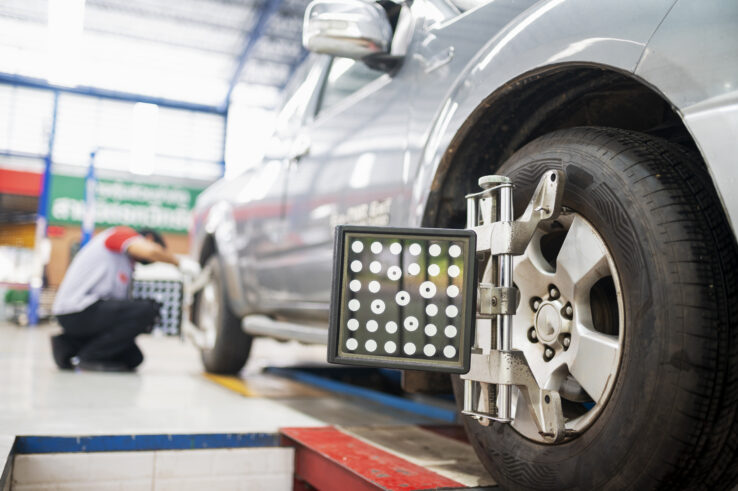

You just got your car back from the shop after an accident. The dent is gone, the paint matches, and everything looks brand new. But if you notice your car pulling slightly to one side, or your steering wheel sits a little off center while you’re driving straight, there may be an issue your eyes cannot catch. That issue is often alignment, and it is one of the most overlooked parts of collision repair.
Why Accidents Throw Off Your Alignment
Your car’s alignment refers to the precise angles of your wheels relative to each other and to the road. Manufacturers set these angles down to fractions of a degree, and even a small impact can be enough to shift them. You do not need a major crash for this to happen. A pothole hit at the wrong angle, a curb bump, or a low speed fender bender can all be enough to push your alignment out of spec, especially around the suspension components and steering linkage that connect directly to your wheels.
After a more significant collision, the risk goes up considerably. Impacts that affect the frame, control arms, or tie rods almost always affect alignment too, even if the damage is not visible from the outside
Signs You May Need a Wheel Alignment
Your car often tells you something is wrong before a warning light ever does. Watch for:
- Your car pulling to one side, even on a flat, straight road
- A steering wheel that sits crooked when your wheels are actually straight
- Uneven or rapid tire wear on one side of a tire
- A steering wheel that vibrates or feels loose at higher speeds
- A general sense that the car feels different to drive since your accident
Alignment Is Not the Same as Balancing
These two terms get mixed up often, so it is worth clearing up. Wheel balancing corrects uneven weight distribution around a tire and wheel assembly, which usually shows up as vibration at certain speeds. Alignment corrects the angles of the wheels themselves. After a collision, both can be affected, but alignment is the one most closely tied to how your car was impacted, since it depends on the suspension and steering components that absorb the force of a crash.
Why This Matters More After a Collision Than Day to Day Driving
Under normal conditions, most drivers get an alignment check once a year or so, or whenever they notice one of the signs above. After an accident, though, alignment deserves a closer look every time, for a few reasons.
First, misalignment causes uneven tire wear, which shortens the life of tires you may have just paid to have repaired or replaced. Second, it affects handling and stability, which matters even more if your car was already weakened structurally. Third, and often overlooked, alignment issues can throw off the calibration of newer safety systems like lane assist and adaptive cruise control, since these systems rely on your car tracking straight and true.
How AutoLux Collision Center Handles Alignment
At AutoLux Collision Center, alignment is not treated as an afterthought or an upsell. As part of our full collision repair process, we check alignment on vehicles that have been in any kind of impact, not just the obvious ones. Our technicians use precision equipment to measure your car against manufacturer specifications, so nothing gets missed just because the damage was not visible on the surface.
If your vehicle also needs frame straightening or sensor recalibration, we handle that under one roof too, so you are not left chasing down separate appointments at separate shops after your accident.
Are Aftermarket Parts as Good as OEM?
This is the question we hear most, and the honest answer is: it depends on the part. For simple components like mirrors, trim pieces, or non-structural panels, quality aftermarket parts can perform just as well as OEM at a fraction of the cost. But for structural components, bumper reinforcement bars, airbags, or anything tied to your vehicle’s crash-safety systems, the precision of OEM parts matters far more. A slightly different steel gauge or mounting point can change how a part performs in a future collision.
This is also where ADAS calibration becomes relevant — many aftermarket parts, especially bumpers and
mirrors housing sensors, can throw off calibration for cameras and radar systems if they aren’t a precise
fit
Will Insurance Use Aftermarket Parts?
Most insurance policies default to aftermarket parts because they’re less expensive, which keeps claim payouts lower. However, you often have the right to request OEM parts.With sometimes at an added cost to you, sometimes at no cost depending on your policy and state regulations. A few states have laws requiring insurers to disclose when non-OEM parts are being used, and some manufacturers’ warranties can be affected if aftermarket parts are installed on a newer vehicle.
If maintaining your vehicle’s warranty or resale value matters to you, it’s worth asking your shop and insurance adjuster directly whether OEM parts are available for your repair before work begins, not after.
Peace of Mind on the Road
A car can look completely repaired and still be out of alignment underneath. If you were in any kind of accident, even a minor one, it is worth having your alignment checked as part of the repair, not as a separate errand for later. Small shifts add up over time, and catching them early protects both your tires and your safety on the road.
Not sure if your alignment was affected? Bring your vehicle to AutoLux Collision Center for a full inspection. We will check it as part of your estimate, so you know exactly what your car needs before any work begins.
AutoLux Collision Center, 9130 Glenoaks Blvd, Sun Valley, CA 91352.
Phone: 747 271 7080.
FAQ
1. Do I need a wheel alignment after a car accident?
It depends on the impact, but it is worth checking after any accident, even a minor one. Impacts that affect the suspension, steering, or frame often shift alignment even when there is no visible damage.
2. What are the signs I need a wheel alignment?
Common signs include your car pulling to one side, a steering wheel that sits off center while driving straight, uneven tire wear, and vibration in the steering wheel at higher speeds.
3. Can a minor fender bender really affect alignment?
Yes. Alignment issues are not limited to major collisions. Even a low speed impact can shift the angles of your wheels enough to cause uneven tire wear and handling issues over time.
4. Does AutoLux Collision Center check alignment after every repair?
We check alignment on vehicles that have experienced any kind of impact as part of our collision repair process, using precision equipment measured against manufacturer specifications.


